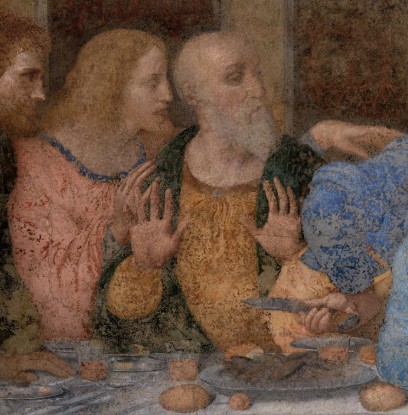
Since I refer to the figure of the Apostle between the traditional Bartholomew and Andrew as Philip, and also because Philip bore a Greek name, I thought of investigating whether there is anything specifically Greek about his depiction in the Last Supper.
Philip may have been known to the Greek pilgrims in Jerusalem. He advises Andrew that certain Greeks wish to meet Jesus, and together they inform Jesus of this [1].
Even proponents of a different view of the naming of the Apostles can examine whether the master Leonardo could have used the motif of Greekness in his depiction of the Apostles.
The Hairstyle and Byzantine link
His hair is long, flowing, and meticulously parted in the center. This style is deeply rooted in Byzantine iconography (the Greek-speaking Eastern Church) which represented for Leonardo da Vinci and the Renaissance an easily “accessible Greekness”. While many of the other Apostles have short, cropped, or thinning hair (like Peter) or more unkempt locks (like Bartholomew).
The Idealized Form: Unlike the more “grotesque” or highly individualized features of Apostles like Judas or Peter, Philip’s facial structure and hair are governed by Symmetry, a core tenet of Greek Neoplatonism which Leonardo studied. [2]
Comparison of the nearby Apostoles
Bartholomew: has a much more “peasant-like” appearance. His profile is sharp and lacks the soft, idealized “Greek” symmetry of our Philip.
Andrew: is depicted with white hair and a startled expression. His features are more “character-driven,” whereas Philip remains a figure of “Classical Calm” despite the chaos.
Peter: is the archetype of the Roman Church—short, grey hair, rugged, and forceful. He represents the “Latinitas” (Latin/Roman) style, whereas Philip represents the “Graecitas” (Greek) idealized beauty.
The “Greekness” lies in Idealism. While Leonardo might used real-life models for the Apostles (often choosing people with “interesting” or even ugly features to show human variety), our Apostle appears to be filtered through the lens of Greek Statuary. His presence serves as a visual bridge between the mortal Apostles and the divine, idealized figure of Christ.
Comparison with “Philip as in Ponte Capriasca notation”
It is Clasiccal Greek vs. Helenistic Greek.
- Stoic & Reserved: Our Philip remains relatively still, his hands reaching out in a balanced, measured gesture vs. Pathos-filled trait of expressive Greek sculpture.
- Symmetrical hair style vs. Dynamic one.
- Statuesque posture vs. Torsion.
- Smooth drapery (with rhytmic and calm folds of the robe) vs. Complex folds.
If we define “Greek” by the Classical Attic Ideal (like of the statues of Phidias or Polyclitus), then the figure on the left is significantly “more Greek.” The figure on the right is “less Greek” in the sense that he is more human.
The profile
Our Philip is in the Leonardo’s Last Supper depicted in a strict, noble pure profile. This is a profile seen in Athenian coinage and marble reliefs. He is the most “statuesque” person at the table (close to the 5th-century BC Athenian ideal).
“Greek” figures in Leonardo’s other works – Adoration of the Magi (Uffizi, Florence)
In his earlier work Leonardo began developing a visual “spectrum” that ranged from the Classical Ideal to the Human Grotesque. In the Adoration of the Magi, according to scholars [3], Leonardo places a “Philosopher” or “Prophet” like figure on the far bottom left. This figure is old, pensive, and detached. The Adoration Philosopher represents the wisdom of the past looking at the new light of Christ. The Last Supper “Philip”: Represents the wisdom of the future (the Greek Diaspora). He is not just a bystander, he is an active participant in the New Covenant. What they have in common?
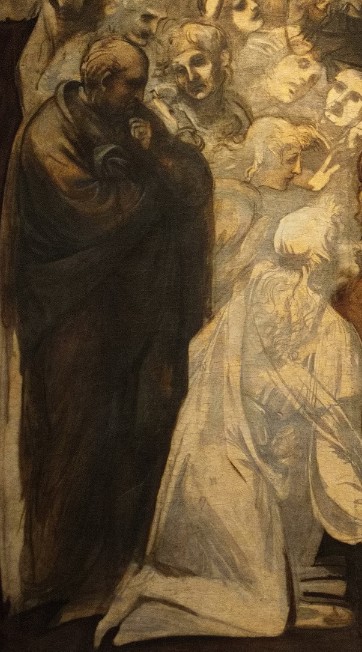
- They are both in a clear profile view, which is relatively rare among the apostoles in this composition.
- They both share the same Nose/Forehead type: Continuous straight line of a nose (Classical).
- Philip’s features are calm, restrained, and classical as well.
- The ear visibility: the ear as depicted in the important Last Supper’s copies by Leonardo’s students carries a visual affinity. This is an important point, which suggests and points out to that the ear was present and not covered with hair in Leonardo’s original.
- These are two forms of visual wisdom: the hand on the chin vs. the short beard. This counterweights and brings attention back to a nose as well.
- Compared to Thomas the Apostle, who matches the Philosopher more in psychological intensity, our Philip is closer match in purely visual terms (profile structure, ear exposure, portrait-like stillness).
Nose types: The “modified“ Greek nose category
Leonardo appears to have been extremely sensitive to the depiction of nose morphology as a way of defining character types.
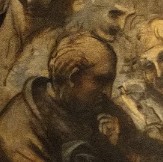
Both figures feature a nose that Leonardo used for “thinkers.” It is a hybrid of the Greek and the Anatomically Correct.
- The Bridge: It is very long and remarkably straight, echoing the Greek ideal.
- The Brow Connection: Unlike the “divine” Greek nose (which has no dip), Leonardo gives both of these men a very slight, realistic indentation at the bridge. This makes them look like intelligent humans rather than distant gods.
- The Tip: In both the Adoration Philosopher and Philip, the tip is slightly more pointed and “Correct” than the rounded, soft tips of younger figures.
- The Long “Philosopher” Bridge: means for Leonardo wisdom, gravity, thought. And we can also find it on his St. Jerome, or Portrait of a Man in Red Chalk.
Jesus and John – in contrast
Jesus is very close to what is called Greek nose (a straight profile from forehead to tip). Leonardo clearly idealizes Christ using classical, harmonious type (balanced, almost geometrically pure).
John is near-classical, but intentionally softened to convey youth and spiritual sensitivity. Leonardo gives Christ the most perfect, classical geometry, and then subtly varies in John to create a gentler echo rather than a duplicate.
Our James the Minor [4] is than closest to a Greek nose among the rest of the Apostoles, which makes him a “resting point” for the viewer’s eyes and balance the painting, even though he kept the leaning pose.
The Venice drawing
In The Venice preparatory study (Accademia, inv. 254) most of the Apostles have Anatomically Correct to Roman noses. They are sharp, jagged, and hooked, because Leonardo was focusing on the “violence” of their shock rather than their beauty.
But the head in the top right corner, labeled Filippo has elongated nose, leaning toward the Philosopher type we discussed: The Bridge is very long and narrow, The Tip is pointier. If we are searching for the “most Greek” Apostle on this specific sheet, Filippo in the top right is the undisputed champion. While he might be more emotionally charged than a traditional “Stoic”, he is rooted deeply in Classical Greek and Stoic iconography.
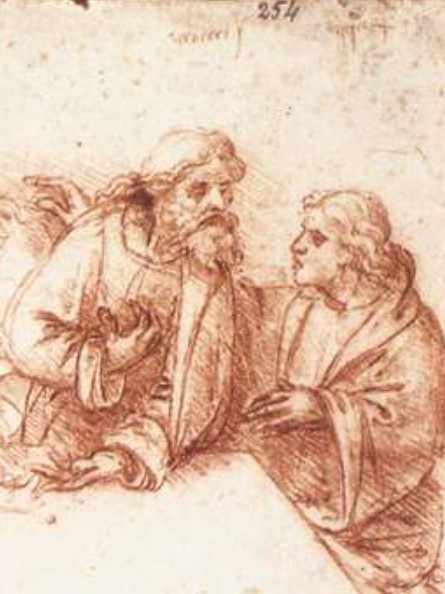
While most of the figures at the table are “Grotesques” or rugged “Roman” types the Filippo head stands out [6] because it follows the Greek Canon: with the unbroken line from the forehead to nostrils and the nose is long, dominating exactly one-third of the face, which follows the mathematical beauty standards of Polyclitus. Leonardo was drawing this head as if he were looking at a marble relief, defining his face with a clean, singular line.
And it is a fascinating paradox: In the Venice study (Accademia 254), the “Filippo” head is actually more Greek than Jesus himself. If you compare the two, Jesus moves away from the rigid Greek profile toward something much more anatomical and human.
In the final mural in Milan, Leonardo actually “Greek-ified” Jesus a bit more. He straightened the bridge of the nose and smoothed out the features to give him a more divine, calm symmetry.
Literature and comments
[1] John 12:19-22
[2] See Raphael’s School of Athens where Leonardo is the model for Plato.
[3] Leonardo da Vinci; Kenneth Clark; 1939 (rev. 1959)
Leonardo da Vinci: The Marvellous Works of Nature and Man; Martin Kemp; 1981 (rev. 2006)
Leonardo da Vinci: The Complete Paintings and Drawings; Frank Zöllner; 2003 (rev. 2017)
The Young Leonardo; Larry J. Feinberg; 2011
Leonardo. Il Giardino di San Marco; Antonio Natali; 2014
[4] Third Apostle on the right side, “the tallest” and standing figure. We interchange Philip and James the Minor from Ponte Capriasca’s labelling. This holds well even if James the M. is a relative of Jesus [5].
[5] Juxtaposed with The Venice drawing there is a figure written Filipo (whose letters are closer to Iacopo in comparison to those of Filippo from the same sheet). As written in the previous, he developes into this “the tallest”, leaning Apostle. By considering him James the Minor, Jesus’ familiar, we explore their visual closeness: and we can find basic physiognomic kinship, they both have a “Naturalist-Ideal” nose bridge with a shallow or gracefull glabella dip.
[6] Matteo’s (Matthew) nose has a perfect bridge, unbroken line. While the Philosopher and the top-right Filippo have “bladed,” narrow noses that suggest a sharp, searching intellect, Matteo’s nose is broader and more robust (or more solid). This with a powerful, protruding brow, creates a visage of someone who already knows.
Iacopo Magiore (James the Major) has a same straight bridge, but especially the tip is wider.
Andrea’s (Andrew) nose is long, but thick and bulbous, it is an “old man” version.