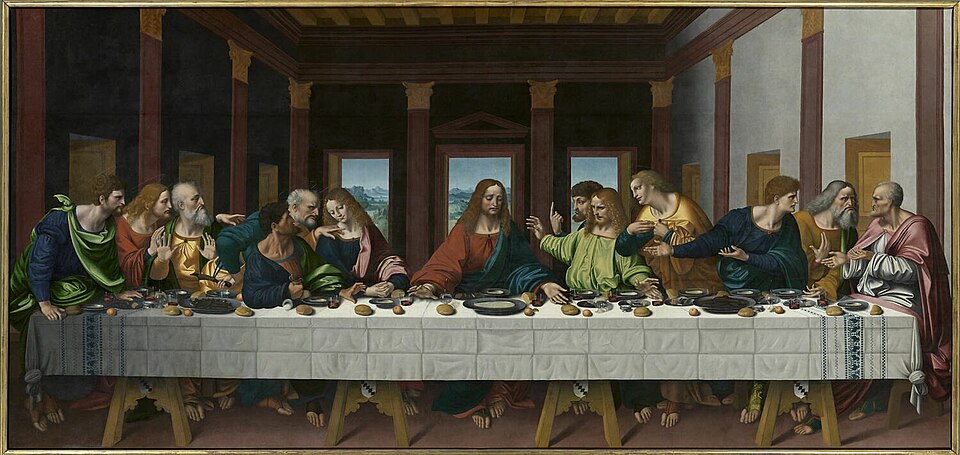
(The title page shows Oggiono’s Last Supper, a copy after Leonardo.)
As Stano Lajda reads Leonardo’s composition of The Last Supper as an open Bible: the darker left half evokes the Old Testament and the history preceding Christ, while the brighter right half unfolds the New Testament and subsequent Christian history toward the Last Judgment, with Christ forming the central hinge between the two [1] – his exploring also brought the interpretation of symbolics and colours. Particularly interesting was the explanation of the fresh early spring green on James the Greater’s clothing as a colour representing the early Christians [2] and Matthew’s blue as a colour used to depict the soul, similar to the colour of the forget-me-not flower. [3]. Certainly, the exact meaning of the all of individual shades of colour cannot be found with definitive validity, when, for example, blue could have arisen as a different combination of basic dyes like azurite or ultramarine (lapis lazuli). [4]
For easier orientation in the symbolism, it may be helpful to view the 4 triads of apostles from left to right as:
- The beginning of history
- The three representing Jesus’ immediate contemporaries
- Jesus’ followers in general
- The triad of the Last Personal Judgment
The bright yellow of the Apostles’ garments may even function as an evocation of royal gold. Blue, from the most valuable dye, may also have the meaning mentioned by Lajda as depicting the soul or at the beginning of the creation of the world, the colour of water (which forms the earthly realm together with green).
At this point we express the interpretation of Leonardo’s iridescent red-to-violet colouring [5] in its functional meaning as an evocation of Tyrian purple, with its traditional associations of royalty, dignity and authority. Tyrian purple was a rare, expensive natural organic dye made from sea snails, valued as an imperial status symbol in ancient times, especially in Rome. Of course, in this case it was already a Renaissance equivalent for approaching this dye.
This grandiose and sublime colour was used (created by layering) by the master Leonardo, perhaps on the mantle of the Apostle John and on the last figure on the right, which, according to Lajda, also represents the figure of the Divine Judge in accordance with the depiction of the last three Apostoles. More preciselly to cite Dr. Pinin Brambilla’s description of his clothing: “gray robe with warm-toned mantle” [6] and “from rosy white in the illuminated areas to delicate gray in the half-shadowed area along the edge of the cuff, with an intense crescendo of deep red and violet shading for the dark tones that define shadows.” [7]
And in the description of the Apostle John she continues as: “light-blue robe… …reddish mantle… …original tonality resembles Simon’s mantle, with the same silky, irridescent effects ranging from white to intense crimson and black.” [8, 9]
Furthermore, perhaps in Leonardo’s circle, it was the Apostle John who generally represented the closest disciples, pupils, followers. In any case, in Giampietrino’s copy and in the copy in Tongerlo Abbey, Leonardo’s apprentices moved this colour of the cloaks closer to Jesus’ tunic colour, more closely reflecting the figure of Jesus. Thus slightly shifting its symbolics or iconography as well.
In Leonardo’s, by contrast, a small part (almost triangular in shape) of Judas’ tunic is by Dr. Brambilla also described as “a violet robe” [10] or “a purple robe” [11]. However, this does not seem to be the royal, Tyrian purple of our mentioned Apostoles, but a “muddy” version (a bruised purple) – symbolizing the corrupt royalty. In the copies, on the other hand, this colour is altogether avoided, Leonardo’s apprentices have brought another colour with its own symbolics.
Literature and comments
[0] The featured image is Last Supper by Marco d’Oggiono, after Leonardo da Vinci
[1] [Odhalené] Tajomstvo Leonardovej Poslednej Večere – The [Unveiled] Mystery of Leonardo’s Last Supper; p. 142-145; Stano Lajda; 2024 KUBIKUM
[2] p.168; p. XXVI (pictorial insert in the middle of the book)
[3] p.176-177; XXX (pictorial insert in the middle of the book)
[4] It is interesting to note at this point that Peter’s clothing is probably closest to the blue colour of Jesus’ cloak. [4a, 4b]
In contrary, Judas’ blue part of cloak, unlike the other apostles, is not made of lapis lazuli, which was the most valuable dye. [4c]
[4a] “The cross-section of Christ’s mantle shows that Leonardo first applied azurite and lead white, followed by a layer of particularly dense (135 microns), grainy lapis lazuli. Peter’s robe is chromatically similar. Large, sharp-edged granules of lapis were found, whose size serves to deepen the colour tone.” – Leonardo: The Last Supper; p. 424; Pinin Brambilla Barcilon, Pietro C. Marani; 2001
[4b] p. 425 table
[4c] p. 425 table
[5] We consider garments belonging to a sophisticated white/rose → crimson/deep red → violet/dark chromatic continuum. The symbolic colour can emerge where the modelling of light, shadow, and folds permits it – in deeper red-violet passages.
[6] Leonardo: The Last Supper; p. 361; Pinin Brambilla Barcilon, Pietro C. Marani; 2001
[7] p. 363
[8] p. 379
[9] Because of our previous writings, and because Leonardo anoints in the Venice drawing by his hand “Simone” the next Apostole, we prefer his naming Thaddeus.
[10] Leonardo: The Last Supper; p. 382; Pinin Brambilla Barcilon, Pietro C. Marani; 2001
[11] p. 383