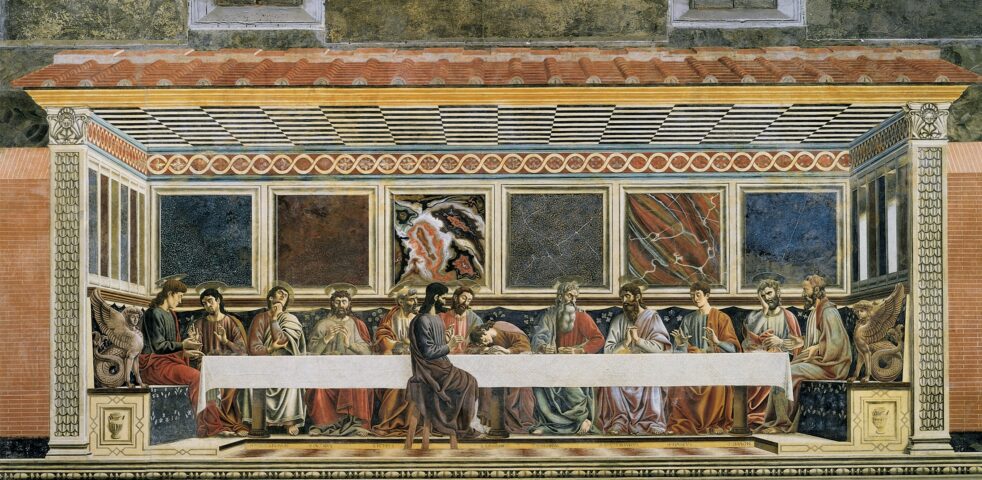
In Renaissance Florence, the powerful guilds, known as “Arti,” were central to the city’s economic, political, and cultural life. [1] Each guild, fiercely proud of its identity, adopted a patron saint who served as its celestial protector and whose image often adorned their meeting places and prominent public spaces like the church of Orsanmichele. [2] Among these heavenly guardians were several of Christ’s Apostles, chosen to represent the values and trades of the guilds.
These Arti included seven major guilds (collectively known as the Arti Maggiori), five middle guilds (Arti Mediane) and nine minor guilds (Arti Minori).
In contrast, the popolo minuto—skilled workers including weavers, spinners, dyers, boatmen, laborers, peddlers and others—despite constituting a majority of the population, were barred from forming guilds.[1]
Major Guilds (Arti Maggiori)
The most powerful and prestigious of the Florentine guilds, the Arti Maggiori, included merchants, bankers, and skilled artisans who drove the city’s economy. Four of these seven guilds claimed an Apostle as their patron [3]:
- Arte del Cambio (Guild of Bankers and Money-Changers): The bankers and money-changers chose Saint Matthew as their patron [2]. Before his calling as an Apostle, Matthew was a tax collector, a profession associated with handling money, making him a fitting protector for this influential guild.
- Arte della Seta (Guild of Silk Weavers): The lucrative silk guild was under the patronage of Saint John the Evangelist. [2] The reasoning for this specific association is not definitively documented but reflects the guild’s high status.
- Arte dei Mercatanti (Guild of Merchants): Also known as the Calimala, this guild of merchants who finished and traded in foreign cloth, chose Saint Thomas as one of their patrons. The famous sculpture of Christ and Doubting Thomas by Andrea del Verrocchio was commissioned for their niche at Orsanmichele. [2]
- Arte dei Vaiai e Pellicciai (Guild of Furriers and Skinners): This guild, dealing in luxurious furs, venerated Saint James the Greater. [2]
The other Major Guilds had patrons who were not Apostles. The Arte della Lana (Wool Guild) was dedicated to Saint Stephen, the first Christian martyr. The Arte dei Giudici e Notai (Guild of Judges and Notaries) honored Saint Luke the Evangelist. [2, 4] While an Evangelist and a significant figure, he was not one of the twelve Apostles. The Arte dei Medici e Speziali (Guild of Doctors and Apothecaries) had the Virgin Mary as their patron. [2] The usual patron saint of the medical professions can be Saint Luke as well, but in Florence he was the patron saint of the Guild of Judges and Notaries.
Middle Guilds (Arti Mediane)
The five Middle Guilds represented a range of essential crafts and trades. At least two of these guilds were under the protection of an Apostle.
- Arte dei Beccai (Guild of Butchers): The butchers’ guild claimed Saint Peter as their patron and his statue was placed in their niche at Orsanmichele. [2]
- Arte dei Calzolai (Guild of Shoemakers): The shoemakers were protected by Saint Philip. A statue of the Apostle by Nanni di Banco was commissioned for their niche. [2]
The other Middle Guilds included the Arte dei Fabbri (Blacksmiths), who honored Saint Eligius, the Arte dei Maestri di Pietra e Legname (Masters of Stone and Wood), whose patrons were the Four Crowned Saints, and the Arte dei Linaioli e Rigattieri (Guild of Linen Drapers and Peddlers), this guild chose Saint Mark as their celestial guardian. Donatello’s statue of Saint Mark for their niche at Orsanmichele is a celebrated work of the early Renaissance. [2, 5]
Minor Guilds (Arti Minori)
The nine Minor Guilds encompassed a variety of other essential trades. Among them, Arte dei Cuoiai e Galigai (Guild of Curriers and Tanners): this guild chose Saint Augustine of Hippo as its patron saint, while specifically the Tanners chose Saint Philip as their patron saint. [6,7] The guild did not have an external niche in Orsanmichele, but participated in the decoration of the interior pillars with Sant’Agostino fresco attributed to Niccolò Gerini. [6]
Other Florentine Minor Guilds had patrons who were not Apostles, or their patrons are not well documented.
Back to Sant’Apollonia and Conclusion
The patron saints of the individual Florentine guilds massed together on the four sides of the building, thus became the patron saints of the church of Orsanmichele itself. This decoration was entrusted to the “Arti Maggiori” or major guilds, to the ‘Mediane’ or medium guilds, and to the Minor guild of the Armourers and Swordmakers (with their patron Saint George statue again by Donatello). [2]
There is Last Supper fresco at Sant’Apollonia by the Italian Renaissance artist Andrea del Castagno, located in the refectory of the nun convent of Sant’Apollonia, now the Museo di Cenacolo di Sant’Apollonia. With specificum that Apostle John is in the geometric center, stimulating further thoughts for interpretation. Indeed, I tried to find an explanation for the peculiar Apostles’ sitting order. And from left to right, according to annotated names, sit Matthew, Philip, Thomas, James and Peter. And next to Jesus from the other side is the central figure of Apostle John. These are the all and the only Apostolic patrons of Major and Middle Florentine guilds, also depicted on Orsanmichele church’s exterior.
This gives a strong point for this James as James the Greater identity. As the patron of Arte dei Vaiai e Pellicciai (Guild of Furriers and Skinners). And for the five apostles on the left there is safety, the untypical placement of Judas with his back turned to them provides security not only to them.
Literature and comments
[1] https://en.wikipedia.org/wiki/Guilds_of_Florence
[2] http://www.museumsinflorence.com/musei/orsanmichele.html
[3] https://www.britannica.com/topic/arti-maggiori
[4] http://employees.oneonta.edu/farberas/arth/arth213/orsanmichele.html
[5] https://en.wikipedia.org/wiki/Saint_Mark_(Donatello)
[6] https://it.wikipedia.org/wiki/Arte_dei_Cuoiai_e_Galigai
[7] For Florentine Tanners it was the same devotion as for the Shoemakers’ Guild.
[8] Lorenzo Ghiberti finished three Bronze statues for Orsanmichele. [9] Bronze statues were considered more prestigious:
The sculpture of Saint John the Baptist, patron saint of Florence, ordered (again) by Arte dei Mercatanti (Guild of Merchants) – also known as the Calimala.
The sculpture of here earlier discussed Saint Matthew ordered by Arte del Cambio (Guild of Bankers and Money-Changers).
The already mentioned sculpture of Saint Stephan ordered by The Arte della Lana (Wool Guild).
In Ghiberti’s workshop trained for example Donatello, Masolino, Paolo Uccello, or Antonio del Pollaiuolo.
[9] https://en.wikipedia.org/wiki/Lorenzo_Ghiberti
[10] After my initial idea that all the Apostles on the left side should be Florentine patrons of guilds, created with a help of AI. Then fact checked, crosschecked and interchanged.